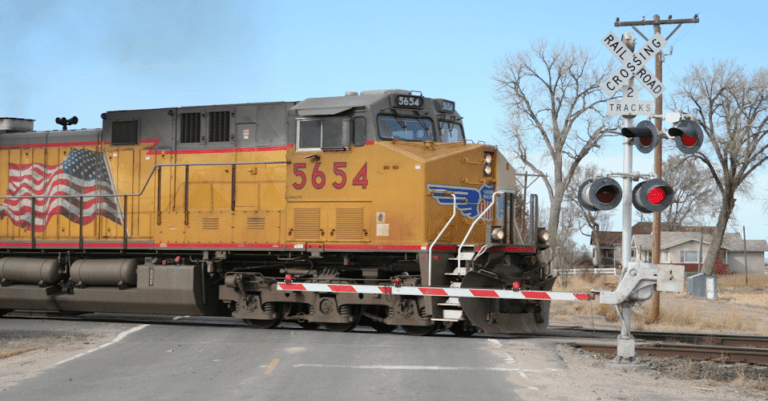
Railroad crossing safety is a critical component of defensive driving, governed by the uncompromising reality that a train cannot stop quickly. A typical freight train traveling at 55 miles per hour requires more than a mile—the length of eighteen football fields—to come to a complete halt. Because the physics of a collision between a five-ton vehicle and a six-thousand-ton train are invariably catastrophic, railroad safety laws are designed to eliminate any possibility of contact.
The most fundamental law is that trains always have the right-of-way. Drivers must yield to all rail traffic, regardless of whether the crossing is “active” with gates and lights or “passive” with only a crossbuck sign. When lights begin to flash or gates start to lower, motorists are legally required to stop no closer than fifteen feet from the nearest rail. A common and fatal mistake is attempting to “beat the gate”; once the lights activate, the train is often much closer and moving faster than it appears due to an optical illusion known as the Monon Effect.
Safe crossing techniques also involve proactive vehicle management. Drivers should never shift gears while crossing tracks, as this increases the risk of stalling. Furthermore, it is essential to follow the “all or nothing” rule: never enter a crossing unless there is enough space on the other side to clear the tracks completely. Being “trapped” on the tracks by stop-and-go traffic is a leading cause of rail-related fatalities. If a vehicle does stall or become stuck, occupants must evacuate immediately and run toward the direction of the incoming train at a 45-degree angle to avoid being hit by debris upon impact. By respecting the immense power of rail traffic and adhering to stop-line regulations, drivers ensure that these intersections remains safe for everyone.
🚂 Rail Safety Essentials
- The 15-Foot Rule: Stop between 15 and 50 feet from the nearest rail when lights flash.
- Don’t Shift: Keep a steady speed and avoid changing gears over the tracks.
- Expect a Second Train: On multi-track crossings, wait for the gates to rise fully; a second train may be hidden by the first.
- Emergency Contact: Look for the Blue Sign (ENS) at the crossing to report stalls or obstructions to the railroad dispatcher.
