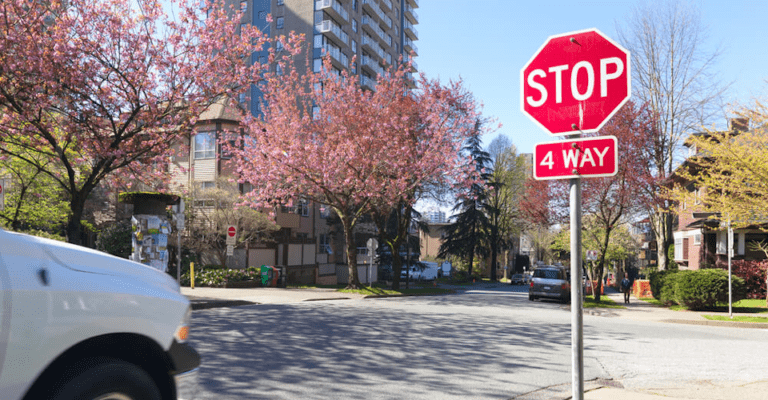
Right-of-way rules at a four-way stop are designed to create a predictable sequence of movement, transforming a potential point of conflict into a synchronized flow of traffic. The most fundamental rule is the principle of “first to arrive, first to proceed.” The vehicle that reaches the intersection and comes to a complete stop first holds the legal right-of-way. This requires drivers to pay close attention not just to their own path, but to the arrival times of vehicles on the cross-streets.
When two or more vehicles arrive at the intersection simultaneously, a secondary rule applies: the driver on the left must yield to the driver on the right. This “yield to the right” rule is a universal standard in driving that prevents confusion during ties. By always deferring to the vehicle on their right, drivers establish a clockwise rotation that keeps the intersection clear. If two vehicles are facing each other and arrive at the same time, they can both proceed straight simultaneously as their paths do not cross. However, if one intends to turn left while the other is going straight, the left-turning driver must yield to the driver going straight.
Effective communication is the final pillar of four-way stop safety. Drivers should use their turn signals well in advance to announce their intentions, allowing others to plan their movements. If there is any ambiguity or if another driver seems hesitant, making eye contact or using a simple hand wave can resolve the situation safely. It is always better to yield your right-of-way to avoid a collision than to insist on it and cause an accident. In essence, four-way stops rely on a combination of strict mechanical rules and social cooperation, ensuring that patience and order prevail over haste and aggression.
——————————
Quick Summary of Rules
* Arrival Order: The first car to stop is the first car to go.
* The Tie-Breaker: If you arrive at the same time, yield to the car on your right.
* Turning: Left-turning vehicles yield to oncoming traffic going straight.
* Communication: Always use signals and make eye contact with other drivers.
