
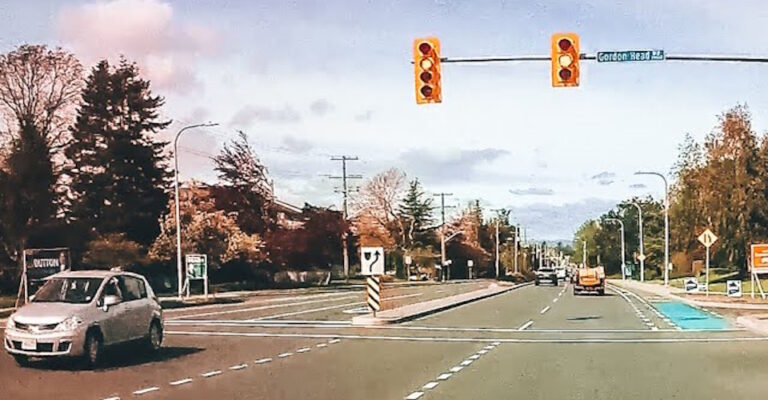
he “Point of No Return” is a critical mental threshold every driver must establish when approaching a signalized intersection. It represents the specific distance from the stop line beyond which a vehicle can no longer safely stop if the traffic light transitions from green to yellow. Understanding this concept is essential for preventing two of the most common intersection hazards: abrupt rear-end collisions caused by slamming on the brakes and dangerous “T-bone” accidents caused by entering an intersection too late in the yellow cycle.
Identifying this point requires a constant evaluation of speed, road conditions, and following distance. As a driver approaches a green light, they should visually mark a spot on the pavement—often designated by a specific pavement marking or a utility pole—that serves as their decision line. If the light turns yellow before the driver reaches this mark, they should have ample space to apply the brakes comfortably and stop. However, if the light changes after they have passed this point, they are committed. In this case, attempting to stop would likely result in the vehicle stranding itself in the middle of the intersection or causing the driver behind to crash into them.
The physics of the “Point of No Return” changes with the environment. On a high-speed rural road, the point is much further back than on a slow city street. Furthermore, if the road is wet or icy, the point must be extended significantly to account for reduced friction. A common mistake is “accelerating to beat the light” once the point is passed; instead, the driver should maintain a steady speed and proceed through the intersection with caution. By proactively identifying this transition zone at every green light, drivers replace indecision with a clear, safe plan of action.
🚦 Yellow Light Decision Matrix
- The 3-Second Rule: Most yellow lights last at least 3 to 6 seconds.
- Check the Rearview: Before reaching the point, know if someone is tailgating you.
- Never Speed Up: If you have to floor the gas to make it, you haven’t reached the point.
- Stale Greens: If a light has been green for a long time, assume the point is approaching.
